Cookie Preferences
We use essential cookies to ensure our website functions correctly. No tracking or advertising cookies are used. By continuing, you accept our use of essential cookies.
Why aftercare decides the outcome
A detail is a starting condition, not a permanent state. What happens to your paint over the following two years is decided almost entirely by how it is washed — not by which coating went on it. Every swirl mark we remove was put there by a wash, a dry or an automatic car wash, and the same routine that created them will recreate them on corrected paint within a season. This guide is the method we use ourselves, written so you can use it at home.
If you want the detail behind why those marks form in the first place, the paint correction guide covers what is physically happening in the lacquer.
The safe wash, step by step
Seven steps, in order. None of them require professional equipment — the difference between this and a driveway wash is sequence and discipline, not kit.
-
01
Work in the shade, on a cool panel
Never wash in direct sun or on paint that is warm to the touch. Shampoo and water dry on the surface before you can rinse them, and the mineral deposits left behind are the water spots that then need polishing off. Early morning or a shaded space, always.
-
02
Rinse before anything touches the paint
A thorough pressure rinse from the top down removes the loose grit that does the most damage. Everything you can float off the panel now is grit you are not about to drag across it with a mitt.
-
03
Pre-wash with snow foam and let it dwell
A citrus pre-wash or snow foam lifts road film chemically rather than mechanically. Give it several minutes to work — the point of dwell time is that the chemical does the abrasion so your mitt does not. Rinse it off completely before contact.
-
04
Set up two buckets with grit guards
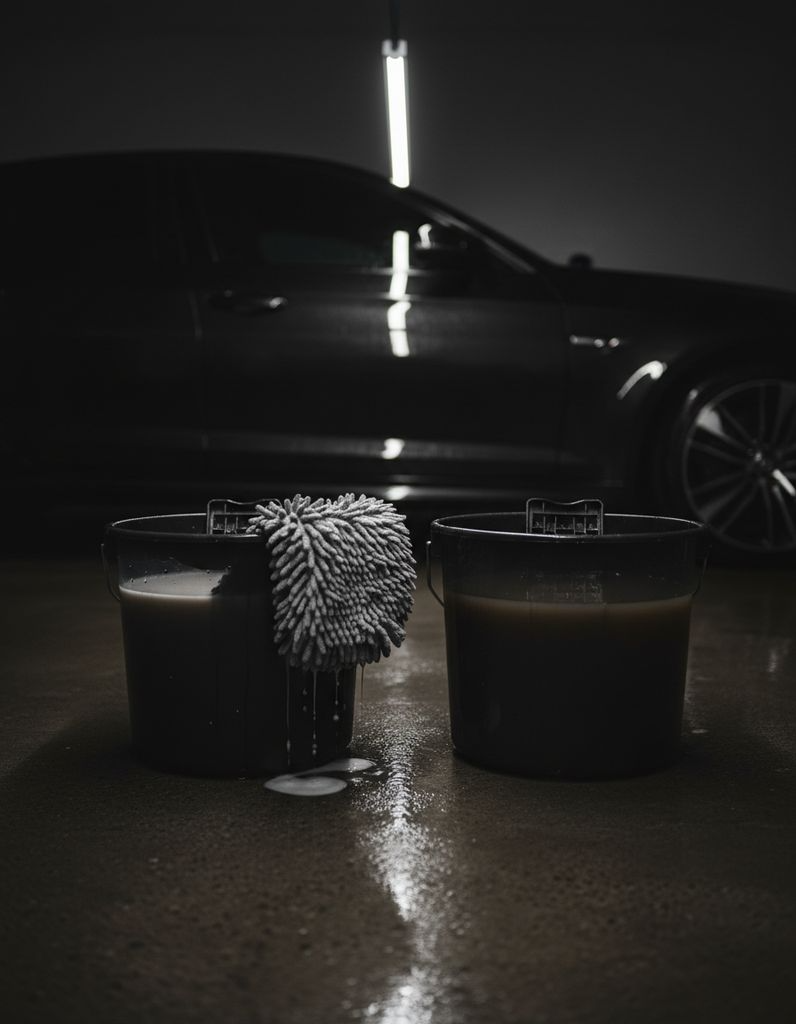
One bucket holds shampoo solution, the other clean rinse water, each with a grit guard in the bottom. This is the single change that separates paint that stays swirl-free from paint that does not. A one-bucket wash returns the dirt you just removed straight back onto the panel.
-
05
Wash top down, rinsing the mitt every panel
Use a pH-neutral shampoo and a clean microfibre mitt. Do one panel, then rinse the mitt in the rinse bucket, agitate it against the grit guard, and reload from the shampoo bucket. Sills, lower doors and the rear bumper are the dirtiest areas — do them last, or use a separate mitt entirely.
-
06
Rinse fully, then dry without dragging
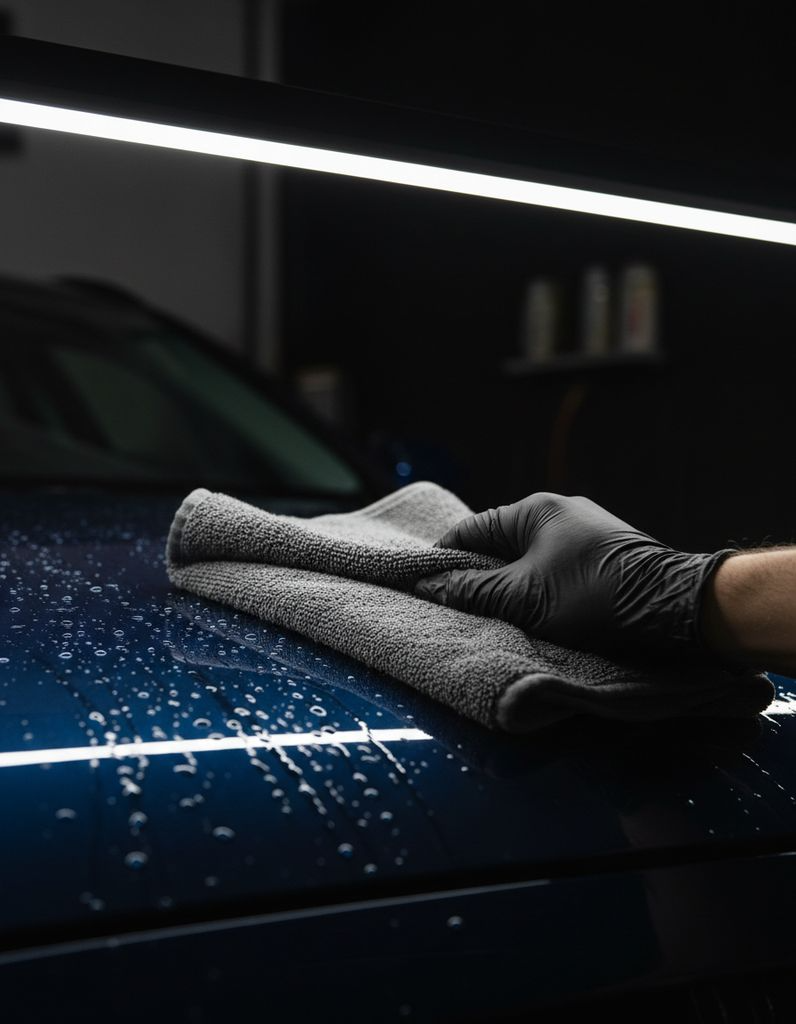
Rinse from the top down until the water runs clear. Dry with a clean, plush microfibre drying towel laid onto the panel and drawn gently — not scrubbed. A stiff or previously dropped towel scratches as effectively as a sponge, and dry-wiping dust off an unwashed panel is the most common single-panel damage we see.
-
07
Top up the protection, not the shine
A ceramic detail spray or coating maintenance topper after drying keeps the water behaviour sharp and adds a sacrificial layer. Avoid anything described as a wax-infused shampoo or a filler glaze on a coated car — it sits on top of the coating and dulls exactly the hydrophobic behaviour you paid for.
What to keep away from the paint
Avoiding these five matters more than anything you can add to the car.
- Automatic and brush car washes. They are the single largest cause of the damage we correct, and one pass can undo work that took a day. Touchless washes are less damaging but use aggressive chemistry that shortens coating life.
- Traffic film removers and any strongly alkaline or acidic cleaner on coated paint. They strip protection. A pH-neutral shampoo is all a coated car needs, because the coating is doing the work.
- Sponges, brushes, chamois leathers and old bath towels. All of them trap grit and none of them release it. Microfibre only, and retire it once it has been dropped.
- Washing in direct sun, or letting the car air-dry. Both put water spots into the finish, and on a coated car those spots etch into the coating rather than the paint — which is a coating problem to remove, not a wash problem.
- Parking under trees or beside industrial sites for long periods. Bird lime, sap and iron fallout are acidic and etch quickly. A coating buys you time to remove them safely, not permission to leave them.
How often, realistically
A protected car asks for less attention, not none. This is the cadence we recommend to owners who want the finish to still look right in two years.
Wash
A coated car cleans far more easily than an uncoated one, but contamination still lands on it. Regular light washes are gentler on paint than occasional heavy ones, because there is less to remove each time.
Decontamination
Iron fallout and tar bond to the surface regardless of protection. A chemical decontamination once or twice a year keeps them from building up to the point where a clay bar is needed.
Maintenance detail
Our from £60 maintenance detail exists for exactly this — a proper safe wash, decontamination and protection top-up, taking 90–150 minutes. Owners on a schedule almost never need correcting again.
Glass coating renewal
Gtechniq G1 Clear Vision is rated at 12 months, which is shorter than a body coating because a windscreen takes constant wiper abrasion. It is renewed on its own rather than requiring anything else to be redone.
The maintenance detail exists to take this off your hands entirely, and our process page sets out what a visit involves. Owners on a regular schedule are the ones who tend to leave the longest reviews.
What you should expect to last
Manufacturer durability ratings assume the car is maintained. A neglected coating will underperform them; a maintained one usually meets or beats them.
- Gtechniq Crystal Serum Light
- 2 years
- Gtechniq EXO V4
- up to 5 years layered over Crystal Serum Light
- Gtechniq G1 Clear Vision
- 12 months
- Premium paint sealant
- 6 months
What each of these is and when it is the right choice is covered in the ceramic coating guide.
Maintenance questions we get asked
More on the main FAQ. If the paint is already past what washing can fix, the correction guide explains what can be recovered — and recent work shows it on real cars.